
Expert Obstructive Sleep Apnea Treatment in Fort Lauderdale
4.8 rating on Google · 338+ reviews
Chronic snoring, morning headaches, and daytime exhaustion are your airway telling you something. Dr. Boris Lipovetskiy, DMD, uses custom mandibular advancement devices – not CPAP to keep your airway open while you sleep. Neuromuscular precision. Enamel-safe. Bruxism and TMJ treated simultaneously.
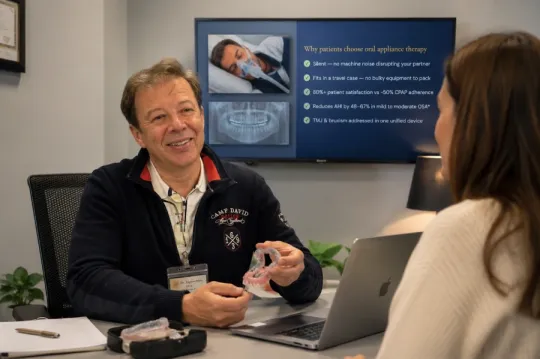
Why patients choose oral appliance therapy:
- Silent – no machine noise disrupting your partner
- Fits in a travel case – no bulky equipment to pack
- TMJ & bruxism addressed in one unified device
Understanding obstructive sleep apnea
OSA is a mechanical problem – and dental medicine can solve it. During sleep, the muscles of the posterior throat relax. In OSA, they relax too far – soft tissue collapses and blocks the airway. The brain triggers a micro-arousal to restore breathing. This cycle can repeat dozens of times per hour, preventing restorative sleep and starving the body of oxygen.

Disruptive snoring
Loud snoring punctuated by silence, then sudden gasps or choking – often noticed by a partner before the patient.
Morning symptoms
Waking with a dry mouth, sore throat, or dull headache – signs the airway was compromised throughout the night.
Daytime fatigue & brain fog
Excessive sleepiness despite spending 7–8 hours in bed. Difficulty concentrating, memory lapses, increased irritability.
Nocturnal bruxism
Grinding or jaw clenching is often the body's reflexive attempt to reopen a narrowed airway – not a separate habit. Treating OSA frequently resolves it.
Partner-reported breathing pauses
A bed partner noticing moments of complete silence – then a sudden gasp is a strong clinical indicator of obstructive apnea events.
3×
Higher hypertension risk in untreated OSA patients
30×
Apnea events per hour possible in moderate OSA
80%
Of OSA cases estimated undiagnosed in the US
Why most patients prefer a custom oral appliance over CPAP
CPAP remains the gold standard for severe OSA. But for mild to moderate cases – and for patients who find CPAP intolerable – the American Academy of Sleep Medicine endorses oral appliance therapy as a clinically proven alternative. Here's how they compare in real life.
Silent, precise, travel-ready
A mandibular advancement device gently positions the lower jaw forward during sleep, preventing tissue collapse and maintaining a clear airway — with no noise, no mask, and no power source required.
Fabricated with iTero 3D digital impressions – precise fit from day one
Silent operation – no noise disrupting your partner
Fits in a shirt pocket – no cumbersome travel equipment
80%+ patient satisfaction rate in clinical studies
Treats bruxism and TMJ dysfunction simultaneously
AHI reduction of 48–67% in mild to moderate OSA*
Effective but often abandoned
CPAP is the reference standard for moderate to severe OSA – and is essential in those cases. But real-world adherence is a persistent clinical challenge, with many patients discontinuing within the first year.
Bulky mask – often causes claustrophobia and skin irritation
Machine noise disrupts partner's sleep
Requires power source – limits travel flexibility
Long-term adherence drops to ~50% in many patient groups
Does not address bruxism or TMJ dysfunction
No dentist involvement – bite and jaw health unmonitored

OSA is a mechanical blockage – and jaw position is the key lever
"My task is to identify the dental and neuromuscular factors that may be impairing your breathing. A recessed jaw doesn't just cause cosmetic concerns — it narrows the airway. Tekscan analysis often reveals how a misaligned bite triggers grinding as a reflexive attempt to reopen that space."
Unlike central sleep apnea — a neurological signaling disorder — obstructive sleep apnea is a physical, mechanical problem. Because jaw positioning and bite alignment directly influence airway space, a trained neuromuscular dentist can meaningfully address the root cause without surgery or continuous air pressure.
Dr. Lipovetskiy treats OSA, bruxism, and TMJ dysfunction as an interconnected system — not three separate problems. By optimizing jaw alignment through a custom MAD, the same device that holds the airway open also relieves the grinding pattern and reduces joint strain. When severe bite collapse or widespread tooth damage is also present, appliance therapy may serve as the stabilizing first phase of a full-mouth reconstruction.
Unified neuromuscular strategy
OSA, bruxism, and TMJ addressed simultaneously through one precisely calibrated appliance.
Coordinated medical care
Dr. Lipovetskiy partners with certified sleep physicians – the dentist fits the device, the physician diagnoses.
No surgery. No CPAP.
A custom MAD is the least invasive, most portable path to a clear airway – and is AASM-endorsed.
Biocompatible, enamel-safe
Fluoride-free and mercury-free practice. Every appliance is designed with long-term bite integrity in mind. This focus on conservative care and long-term bite health is consistent with our holistic approach.
What happens before we design your appliance
We never fabricate an oral appliance without first building a full clinical picture. Our diagnostic protocol maps the relationship between your bite, jaw joints, and airway anatomy – ensuring the therapy is calibrated to your unique physiology.
1. Clinical consultation & sleep history review
An in-depth review of your snoring patterns, daytime symptoms, partner observations, and existing sleep study results. We map the full picture of your sleep health before any imaging.2. iTero 3D digital impressions
High-accuracy digital models replace uncomfortable traditional putty molds. These are used to fabricate your custom MAD appliance to exact tolerance – ensuring a comfortable fit from the first night.3. 3D CBCT airway imaging
Cone-beam CT scans visualize the actual anatomy of your airway and jaw structure in three dimensions. CBCT reveals narrowing or structural factors that standard imaging cannot detect.4. Tekscan occlusal analysis
A digital pressure-mapping system that shows exactly how your bite forces are distributed – identifying imbalances that contribute to bruxism and confirming whether a recessed jaw is narrowing the airway.5. Physician coordination & sleep study
Dr. Lipovetskiy works as your dental treatment partner alongside board-certified sleep physicians who provide the formal OSA diagnosis through polysomnography. Your medical diagnosis and dental treatment are aligned from day one.
A formal sleep study (polysomnography) is required for an OSA diagnosis.
The dentist's role is to design and fit the oral appliance based on that clinical diagnosis — not to diagnose sleep disorders independently.Who is an ideal candidate for oral appliance therapy
The American Academy of Sleep Medicine recognizes oral appliance therapy as a first-line treatment for specific patient profiles. A clinical assessment confirms eligibility and ensures the device is appropriate for your case.
Mild to moderate obstructive sleep apnea (AHI < 30)
CPAP-intolerant patients — machine too loud, mask causes anxiety
Active TMJ dysfunction or nocturnal bruxism alongside sleep disorder
Frequent travelers who need a portable, power-free solution
Patients seeking a silent, discreet alternative to CPAP
Healthy dentition capable of supporting the appliance
Severe OSA (AHI > 30) — typically requires CPAP or surgical evaluation
Significant tooth loss or unstable restorations that can't support a MAD
Acute, unstable TMJ flare-up requiring stabilization first
Central sleep apnea — a neurological issue, not a mechanical blockage
Active periodontal disease requiring treatment before appliance therapy

Not sure which category you fall into?
That's exactly what the consultation is for. Dr. Lipovetskiy reviews your sleep study results, evaluates your oral health, and determines whether a custom MAD – or a combination approach – is the right path. There's no commitment required at the first visit.
How oral appliance therapy works
1. Consultation & Sleep Study Review
We review your existing polysomnography results, discuss symptoms, and photograph your bite with our Kodak intra-oral camera. If you haven't had a sleep study yet, we refer you to a certified sleep physician.2. Full Diagnostic Work-Up
iTero digital impressions, 3D CBCT airway scan, and Tekscan bite analysis. This maps your airway anatomy and jaw mechanics before any appliance is designed.3. Custom MAD Fabrication
Your appliance is precision-fabricated from your digital impressions. We choose the device type, jaw advancement angle, and material based on your specific clinical profile – never a generic boil-and-bite.4. Fitting, Follow-Up & Monitoring
The device is fitted and adjusted until comfort and airway patency are confirmed. Follow-up visits monitor bite stability and allow fine-tuning. Most patients adapt within 2–4 weeks.Adaptation timeline:
Most patients notice an immediate reduction in morning symptoms. Full adaptation to wearing the device typically occurs within 14–28 days. Temporary jaw soreness and increased salivation resolve on their own in the first 1–2 weeks.Oral Appliance Therapy & After Results
Results shown reflect patient-reported outcomes after custom MAD therapy at ADW Center. Individual outcomes vary based on OSA severity, anatomy, and compliance.


52-year-old patient · CBCT revealed severely narrowed airway
Complete resolution of chronic fatigue and morning headaches within 6 weeks
Patient had discontinued CPAP within 3 months of diagnosis
Switched to custom MAD · AHI reduced · sleeping through the night consistently

Tekscan revealed bite imbalance linked to both symptoms
Single hybrid orthotic resolved snoring, TMJ pain, and nighttime grinding
Patient reviews
Dr. Lipovetskiy diagnosed a jaw alignment issue I had no idea was related to my snoring. The device he made is so comfortable I forget I'm wearing it. My husband finally sleeps through the night too.
Couldn't tolerate the CPAP mask at all. Dr. Lipovetskiy's team took my sleep study results and made me a custom appliance. Took about two weeks to get used to, but now my sleep is better than it's been in a decade.
I had terrible jaw pain from grinding plus mild sleep apnea. Dr. Lipovetskiy designed one appliance that addressed both. The Tekscan analysis was eye-opening — I had no idea my bite was so unbalanced. Highly recommend.
FAQ
Can a dentist genuinely treat obstructive sleep apnea?
Yes – for mild to moderate OSA, a trained neuromuscular dentist can provide oral appliance therapy using a custom MAD. Dr. Lipovetskiy works alongside certified sleep physicians who provide the formal OSA diagnosis. The dentist's role is to design the device and manage TMJ and bite concerns that directly affect airway patency.
What's the difference between a MAD and a standard night guard?
A basic night guard only protects tooth enamel from grinding – it does nothing for airway patency. A mandibular advancement device is a functional appliance that repositions the lower jaw forward to maintain a clear airway during sleep. Dr. Lipovetskiy can often fabricate a hybrid orthotic that fulfills both roles in a single device.
How long does it take to adapt to the oral appliance?
Most patients adapt within 2–4 weeks. Initial side effects – mild jaw soreness, increased salivation — resolve on their own within 14 days. We schedule follow-up visits to fine-tune jaw position and verify both comfort and airway improvement are confirmed.
Is oral appliance therapy covered by insurance?
Most PPO medical insurance plans (not dental) offer coverage for custom MAD devices when a formal sleep study diagnosis is on file. Our team verifies your specific benefits before treatment begins. CareCredit financing is also available in-office to ensure therapy remains accessible.
How long will my oral appliance last?
With appropriate care, a high-quality custom orthotic lasts 2–5 years. We provide detailed hygiene instructions and schedule periodic inspections to monitor bite stability and appliance integrity over time.
Is OAT a valid CPAP alternative at your Fort Lauderdale clinic?
For the majority of adults with mild to moderate OSA, oral appliance therapy is a life-changing alternative – and is formally endorsed by the American Academy of Sleep Medicine. It is silent, travel-ready, and significantly more comfortable for daily use. If CPAP has failed you, schedule a consultation to discuss whether a custom MAD is right for your case.
Schedule a consultation. Dr. Lipovetskiy will review your sleep study, evaluate your jaw and airway, and design a treatment plan built around your specific anatomy – not a generic protocol.
- Consultation
- Personal plan
- Written estimate