
Dentures in Fort Lauderdale
4.8 rating on Google · 338+ reviews
A practical removable option for replacing missing teeth.
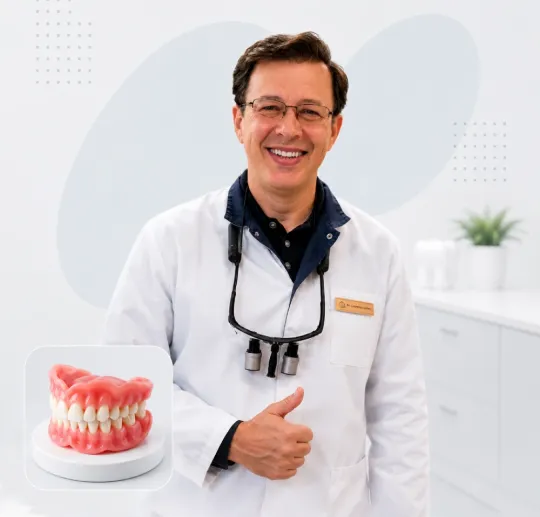
Dr. Boris Lipovetskiy provides full, partial, flexible, and immediate dentures planned around your bite and comfort. In selected cases, immediate dentures can be placed after extractions to reduce the time spent without teeth.
- 30+ Years Experience
- Custom Fit & Bite Planning
- Full & Partial Options
- Financing Available

Restore missing teeth with an option planned around your bite, comfort, and everyday needs.
After your evaluation, Dr. Boris Lipovetskiy will recommend the most suitable solution, including full, partial, flexible, immediate, or implant-retained dentures.
You’ll receive a personalized treatment plan and written estimate before treatment begins.
What Are Dentures?
Dentures replace multiple missing teeth or a full arch and help restore everyday functions such as eating and speaking.
At ADW Center, each denture is planned around your bite, remaining teeth, gums, and comfort. Depending on your needs, treatment may involve removable or implant-retained options.
Real Patient Cases

The patient had multiple missing teeth, poor chewing function, and an unstable bite.
A full upper reconstruction with implants and a same-day fixed prosthesis was completed.
The patient had complete tooth loss in both jaws.
The lower jaw was restored with implants and a fixed hybrid restoration, while the upper received a removable prosthesis.
Types of Dentures We Offer
These options differ in their support, materials, stability, and maintenance.
Full Dentures
A full denture replaces all teeth in the upper or lower arch when they are missing or cannot be predictably restored.
It rests on the gums and helps restore appearance, chewing, and everyday function.

Traditional Partial Dentures
A traditional partial denture replaces several missing teeth and uses the remaining natural teeth for support.
Depending on the bite and required retention, the design may include acrylic, clasps, or internal reinforcement. Metal clasps or frameworks are used only in selected cases when additional strength or support is needed.
Immediate Dentures
An immediate denture is prepared before extraction and placed shortly after the teeth are removed, helping reduce the time a patient spends without teeth during healing.
Depending on the clinical situation, flexible materials may be used when several teeth need to be replaced.
Adjustments may be needed as the gums and supporting tissues change during healing.
Flexible Partial Dentures
A flexible partial denture replaces several missing teeth and is made from lightweight thermoplastic that is easy to remove and insert. At ADW Center, flexible materials are used for most partial restorations and may also be considered for immediate dentures after selected extractions.
Suitability depends on the bite, supporting teeth, and required stability.
Implant-Retained Dentures
An implant-retained denture attaches to dental implants for greater stability when eating and speaking.
It remains removable for daily cleaning. Suitability depends on gum health, available bone, and overall health.
Get a personalized recommendation based on your bite, comfort, and oral health.
How Do We Choose the Right Option?
The right option depends on your remaining teeth, bite, oral tissues, and the level of stability you need. Dr. Lipovetskiy evaluates these factors before recommending a removable or implant-supported denture.
For patients considering a fixed full-arch solution, All-on-4 dental implants may also be discussed as an alternative to a removable denture.

the health of the remaining teeth and gums;
the way the upper and lower teeth meet;
chewing forces;
the desired level of stability;
treatment and maintenance preferences.
What Are Dentures Made From?
Denture materials differ in weight, flexibility, strength, appearance, and maintenance.
Flexible materials are commonly used for removable partial dentures and may also be considered for immediate or full-arch restorations.
They are lightweight, durable, and designed for easy insertion and removal.
Acrylic is commonly used for full dentures and allows the dental technician to reproduce the appearance of the gums while supporting the replacement teeth.
Most removable restorations can be planned without a metal framework. In selected cases, a reinforcing mesh, flexible metal clasps, or another form of reinforcement may be used when additional strength or retention is required.
For patients with a history of sensitivity to standard acrylic materials, a specially processed or clear denture base with minimal residual monomer may be considered.
The final material is selected based on the patient’s bite, oral tissues, and previous reactions to dental materials.
Patients should tell the doctor about any past irritation or reactions to dental materials. Alternative materials or processing options may be discussed when needed.
How We Design Dentures to Look Natural
Proper tooth position and the shape of the prosthesis help restore facial support and natural facial contours.

facial proportions and smile shape;
the remaining natural teeth;
the amount of facial support the denture needs to provide;
tooth proportions, shade, and alignment within the bite.
Before the final design is completed, patients can preview the tooth shape and shade. A brighter shade is not always the most natural choice.
How Are Dentures Made at Advanced Dental Wellness?
Dr. Lipovetskiy evaluates the gums, remaining teeth, bite, and the amount of support available for the restoration.
Digital scans or conventional impressions are taken depending on the type of treatment.
The doctor and dental technician select the tooth shape, position, bite height, shade, and base design.
During the try-in, the fit, bite, speech, facial support, and appearance are checked before the final prosthesis is completed.
At the delivery appointment, the doctor confirms that the completed restoration fits properly and does not create obvious pressure points or bite interference.
Follow-up visits allow the fit to be adjusted as the mouth adapts.
If implant-retained treatment is being considered, additional imaging may be needed. A 3D CBCT scan can help evaluate the jawbone and plan implant support.
Removable vs. Implant-Retained Dentures
| Comparison | Removable Option | Implant-Retained Option |
|---|---|---|
| Support | Gums and remaining teeth | Dental implants |
| Removed by the patient | Yes | Yes |
| Implant surgery | Not required | Required |
| Stability | May move while chewing | Usually more stable |
| Cleaning | Removed for daily cleaning | Removed and cleaned around the implants |
Both options are removable, but implant-retained dentures require implant placement and additional cleaning around the attachments.

Looking for More Stability?
I can examine your bones, bite, and treatment goals, and explain which option – removable dentures or implant-supported dentures – might be right for you.
If you’re looking for an alternative to removable dentures, dental implantation in one day may be an option for restoring a full arch with an implant-supported fixed temporary prosthesis.
Insurance and Financing
Advanced Dental Wellness works with PPO insurance plans and can verify available benefits before treatment begins.
Coverage may vary depending on the type of treatment. CareCredit financing is also available for eligible patients.
After your evaluation, you’ll receive a personalized treatment plan and written estimate, including any additional care that may be needed.
Dentures FAQ
Can Dentures Be Placed on the Same Day as Tooth Extraction?
In selected cases, yes. An immediate denture can be placed after the teeth are removed. Because the shape of the mouth changes during healing, it may need to be relined, and a new long-term restoration may be recommended after the tissues stabilize.
Are Flexible Partial Dentures Better Than Acrylic Dentures?
Neither material is better for every patient. Flexible partial dentures can be a good option when appearance and flexibility are priorities, while acrylic options may be easier to adjust, reline, or repair.
Can I Get a Denture Without Metal?
In many cases, yes. Flexible and acrylic options can often be made without a metal framework. However, the final design depends on the bite and the amount of strength and retention required.
Can a Loose Denture Be Relined?
Sometimes. Relining may improve the fit when the restoration is still structurally sound. If it is worn, damaged, or no longer provides a proper bite, replacement may be more predictable.
How Long Does It Take to Get Used to New Dentures?
Many patients become more comfortable within a few weeks, although the adjustment period varies. Follow-up visits may be needed to correct pressure areas and improve the fit.
Schedule a consultation with Dr. Boris Lipovetskiy to discuss your bite, missing teeth, and treatment goals.
After the evaluation, you’ll receive suitable denture options, a personalized treatment plan, and a written estimate.
- Consultation
- Personal plan
- Written estimate