
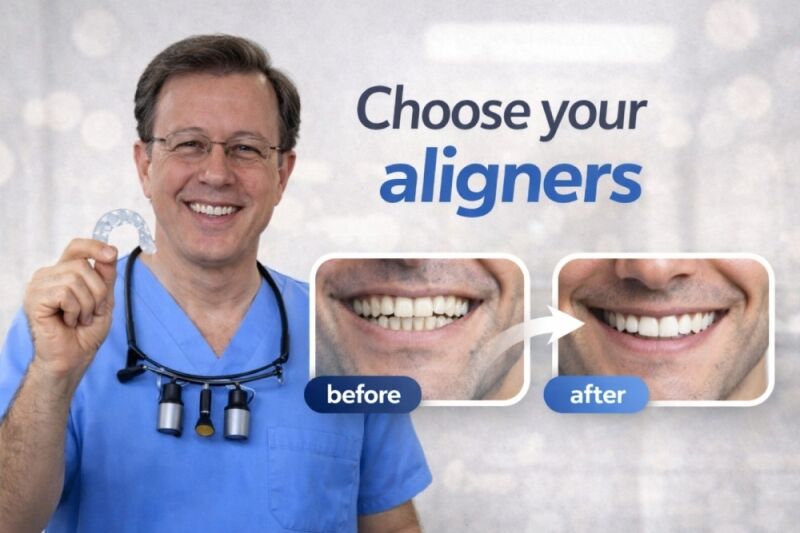
The author of the article
Boris Lipovetskiy, DMD, 31 years experience
Clear aligners are transparent trays used to straighten teeth without braces. They are removable, almost invisible, and don’t interfere with everyday life. Most patients compare SureSmile vs Invisalign when choosing aligners.
Both systems start with a 3D scan of your jaws. Based on this data, custom aligners are made specifically for you. These aligners gradually move your teeth into the correct position.
But even though the principle is similar, there are important differences: technology, brand experience, and the ability to treat more complex cases.
In this guide, we’ll cover:
SureSmile or Invisalign: comparison criteria
While both systems aim to straighten your teeth, the results and treatment process can differ significantly. Here are the key criteria you should use to compare them:
Price: what does the total SureSmile cost or Invisalign cost include?
Accuracy: how predictably will your teeth move?
Treatment Time: how quickly can you achieve results?
Comfort: ease of wearing, pressure on teeth, and adaptation period.
Case Complexity: are they suitable for serious bite problems?
Technology: the software used for 3D planning and monitoring.
Below, we evaluate which system—SureSmile aligners or Invisalign—is the right fit for your specific case.
What Is SureSmile?
SureSmile is a clear aligner system developed by Dentsply Sirona, one of the world’s largest manufacturers of dental equipment. The brand is well-known in the orthodontic community, which is why clinics that work with advanced digital protocols often recommend it.
Key features:
Pricing depends on the number of aligners and treatment stages.
Costs are determined individually after digital modeling.
It is positioned as a modern system with high precision at a more competitive price point.
Who Is SureSmile For?
SureSmile clear aligners are most often chosen by patients with:
Mild to moderate crowding.
Small gaps between teeth.
Minor bite issues (relapse after previous orthodontic treatment).
In more complex clinical cases, your doctor may recommend other systems.
How SureSmile aligners work
The process starts with a 3D scan of your teeth. The doctor uploads the data into the branded software and creates a step-by-step alignment plan.
After that, a series of custom SureSmile aligners is produced for the patient. These trays gradually move the teeth into the correct position. Each set is changed every 1–2 weeks, depending on the treatment plan.
Precise digital planning allows the doctor to see every stage of tooth movement and the final result before treatment even begins. This reduces the risk of errors and makes the outcome predictable.
What Is Invisalign aligner?
Developed by Align Technology, Invisalign has been the market leader for over 25 years. With millions of successful cases worldwide, Invisalign clear aligners are widely considered the “gold standard” in orthodontics.
The strength of the brand
Invisalign is more than just plastic trays; it is a complete ecosystem that includes:
The largest clinical case database in the world.
Proprietary ClinCheck® software for highly precise 3D planning.
SmartTrack® material designed for better control and comfort.
The ability to treat complex bite problems.
The doctor shows in advance how the teeth will move and what the final result will look like. This makes alignment as predictable as possible.
How Invisalign works
After a digital scan, the doctor creates a personalized treatment plan. Based on it, a set of aligners is made for you.
You put on the first pair of trays — they start gently shifting your teeth.
After 1–2 weeks, you switch to the next set, because each new aligner is designed for the next stage of movement.
Your teeth gradually move, and step by step you get closer to the planned result.
Who Invisalign is for
The system is suitable for:
crowding, gaps, and bite issues
teenagers and adults
those who want discreet orthodontic treatment without braces
Invisalign is chosen by patients who want to solve their problem with maximum precision and predictability.
Comparison of SureSmile and Invisalign based on key parameters
Treatment Accuracy
Both systems utilize 3D planning. SureSmile shows stable accuracy for mild to moderate corrections. Invisalign, however, generally handles complex movements better thanks to its massive clinical database and advanced algorithms.
Suitability for Complex Cases
SureSmile is excellent for straightforward issues like crowding and spacing. Invisalign is the preferred choice for complex cases involving significant bite correction, rotations, and major tooth shifts.
Wearing Comfort
Both are clear aligners made of smooth plastic without metal. The trays are thin, laser-cut to the gumline, and generally comfortable to wear.
Treatment Time
Average duration ranges from 6 to 18 months for both. SureSmile can sometimes be faster in simple cases, while Invisalign provides precise control for longer, comprehensive treatments.
Doctor’s Monitoring
In both options, your doctor tracks progress. However, Invisalign offers more advanced tools (like the Invisalign Virtual Care) to fine-tune each stage.
| Criteria | SureSmile | Invisalign |
|---|---|---|
| Manufacturer | Dentsply Sirona | Align Technology |
| Market experience | 5–7 years | Over 25 years |
| Complex cases | Limited | Suitable |
| Accuracy | High | High |
| Price | Usually more affordable | Above average |
| Brand recognition | Medium | Global brand |
Advantages of SureSmile
Advantages of Invisalign
What to choose: SureSmile or Invisalign
Everything is decided individually. Here’s what really matters:
Case complexity
If your case is mild or moderate (for example: slight crowding, small gaps between teeth, or a minor relapse after braces), both options can work.
When the case is complex (significant bite issues, severe crowding, major tooth shifts), Invisalign is more often chosen. The system has more tools for precise correction.
Budget
SureSmile aligners are usually more affordable. This is a good option if you want to straighten your teeth without overpaying for the brand.
Invisalign is more expensive (due to advanced technology and options for complex cases), but it offers more treatment possibilities.
Doctor’s opinion
After an exam, the orthodontist will honestly recommend which system will give the best result in your specific case, considering your bite, timeline, and budget.
Expectations from the result
If you need maximum accuracy and predictability, Invisalign is more often chosen.
If you want a good result at a lower cost, SureSmile is a great option.
What’s right for me?
The most reliable way to understand what will work for you is to come in for a consultation. The doctor will evaluate your bite, perform a 3D scan, and honestly explain which option will work best in your specific case.
FAQ
Your doctor will explain this after diagnosis. SureSmile cost depends on treatment complexity and the number of aligners. On average, the price is lower than Invisalign.
No. All clear aligners must be removed before eating or drinking (except water). This protects the trays from plaque buildup.
The higher price reflects the global brand recognition, the massive investment in R&D, advanced proprietary software (ClinCheck), and the ability to treat the most complex orthodontic cases.
On average, 20–22 hours per day. The stricter you follow the schedule, the faster you’ll get results!