
Sleep Apnea Treatment in Fort Lauderdale
4.8 rating on Google · 338+ reviews
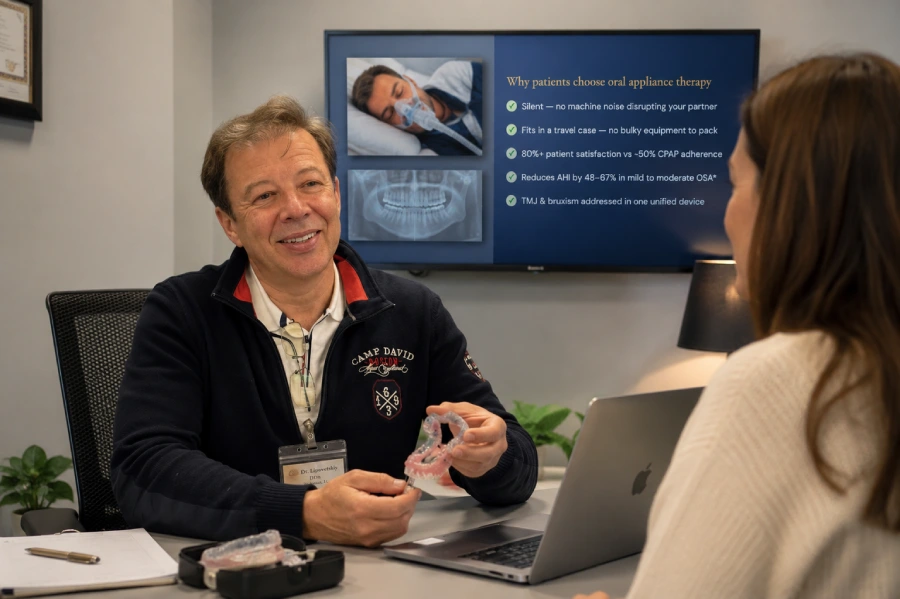
Snoring, waking up tired, or struggling with CPAP (continuous positive airway pressure)? Dr. Boris Lipovetskiy, DMD, provides custom oral appliance therapy for obstructive sleep apnea, with a plan based on your test results, bite, and jaw function.
- 30+ Years of Clinical Experience
- Custom Oral Appliance
- Comprehensive Bite & Jaw Evaluation
- Written Treatment Estimate
Oral Appliance Consultation
Consultations may be complimentary or $99, depending on the appointment type. Before booking, ask which option applies, what imaging is included, and whether diagnostic testing carries a separate fee.
What to expect:
If treatment is recommended, we'll provide a written cost estimate before you proceed. Bring prior study results and details of your CPAP experience.
Schedule Your ConsultationThe cost of a custom oral appliance depends on your treatment needs and follow-up care.
Some medical insurance plans may cover oral appliance therapy for diagnosed obstructive sleep apnea. Coverage and authorization requirements vary.
Third-party payment plans may be available, including promotional interest-free options for qualified applicants.
Our team will review your insurance benefits, payment options, and estimated out-of-pocket costs.
When Is Snoring a Concern?
Frequent, loud snoring can be a sign of obstructive sleep apnea (OSA), a condition that causes repeated airway blockages during sleep. Not everyone who snores has OSA, so a sleep study may be needed to confirm the diagnosis.
Signs that may warrant an evaluation include:
Loud, Frequent Snoring
Especially when it keeps your partner awake.
Pauses in Breathing
Someone notices that you stop breathing briefly or wake up gasping for air.
Daytime Fatigue & Brain Fog
You feel tired, have trouble concentrating, or struggle to stay alert during the day.
Morning Headaches
You regularly wake up with a headache or feel unrested.
Frequent Nighttime Urination
You wake up several times during the night to use the bathroom.
Nighttime Reflux & Disrupted Sleep
Acid reflux and repeated awakenings may also occur alongside OSA.
Untreated OSA is associated with increased risks of high blood pressure, heart disease, and other health problems. Identifying the cause of your symptoms is the first step toward appropriate treatment.
What Is Oral Appliance Therapy?
Oral appliance therapy uses a custom mandibular advancement device to hold your lower jaw forward and help keep your airway open at night. The appliance works without a mask, tubing, or bedside machine.

Easy to carry and use when traveling.
Designed around your teeth, bite, and jaw anatomy.
A discreet option that works without a CPAP machine.
The jaw position can be gradually adjusted to balance comfort and treatment effectiveness.
OrthoApnea NOA: A Custom Sleep Apnea Appliance

At Advanced Dental Wellness, Dr. Lipovetskiy offers OrthoApnea NOA, a digitally designed mandibular advancement device for snoring and mild to moderate obstructive sleep apnea.
It has two custom-fitted trays, called splints, that cover your upper and lower teeth. Their connecting mechanism holds the lower jaw forward while allowing controlled movement.
Custom Digital Design
Made from digital impressions to fit your teeth.
Adjustable Fit
The jaw position can be adjusted during treatment.
Individual Treatment Planning
Your bite and jaw health are evaluated before fitting the appliance.
Who Can Benefit from Oral Appliance Therapy?
- Have mild to moderate obstructive sleep apnea.
- Struggle with CPAP or prefer an alternative.
- Snore regularly and have been evaluated for sleep apnea.

Your teeth and gums must be healthy enough to support the device. We assess existing dental work, jaw joints, and jaw movement before recommending treatment.
For severe OSA, CPAP is generally preferred. If you cannot tolerate it, your physician and dentist can discuss whether an oral appliance is suitable. OrthoApnea NOA is indicated for mild to moderate OSA.
Important: These oral appliances are designed for obstructive sleep apnea. Central or mixed breathing disorders require evaluation by a sleep medicine specialist and may need different treatment.
Oral Appliance Therapy vs. CPAP
Both treatments aim to keep your airway open during sleep, but they work differently.
| Oral Appliance | CPAP | |
|---|---|---|
| How it works | Holds the lower jaw forward | Uses air pressure to keep the airway open |
| Comfort | Custom device worn in the mouth | Mask connected to a machine |
| Travel | Compact and portable | Requires additional equipment |
| Effectiveness | Effective for selected patients with OSA | Generally more effective at reducing breathing interruptions |
| Considerations | May cause jaw discomfort or bite changes | Some patients experience mask discomfort, dryness, or air swallowing |
CPAP is highly effective, but some patients find the mask uncomfortable or have difficulty using it consistently.
A custom oral appliance may offer an alternative without a mask or tubing. Dr. Lipovetskiy can evaluate your dental health and coordinate with your sleep physician to determine whether this approach is right for you.
How Dr. Lipovetskiy Plans Your Treatment
Your assessment focuses on whether the device can be supported comfortably, how far your lower jaw can move, and any dental conditions that need care first.

Sleep & Medical History
We discuss snoring, nighttime awakenings, breathing pauses, daytime fatigue, and how rested you feel. Relevant medical conditions, medications, and family health history are also reviewed.
Teeth, Bite & Airway Evaluation
We check your teeth, gums, bite, and jaw movement, including your jaw joints (TMJs) and signs of grinding. Gum disease, loose teeth, or unstable dental work may need care before an appliance can be fitted.
Dental Imaging When Needed
A panoramic X-ray may be used for a general dental assessment. When clinically indicated, 3D dental imaging (CBCT) can help assess jaw joints, sinuses, or other structural concerns.
Dental imaging does not diagnose sleep apnea.
Digital Appliance Planning
Using iTero digital scans, we capture detailed impressions of your teeth and plan an appliance around your bite and jaw movement.
How Oral Appliance Treatment Works
Consultation & Evaluation
Dr. Lipovetskiy reviews your symptoms, dental health, and prior sleep study results. We also discuss what you hope to improve and any difficulties with CPAP.
If you have not had a sleep study, testing may be arranged, including a home sleep apnea test when suitable. A sleep medicine specialist interprets the results and establishes the diagnosis.
Digital Impressions
We scan your upper and lower teeth and record the measurements needed for a precise fit.
Fitting & Adjustments
At fitting, we check the appliance, explain the prescribed wearing schedule, and show you how to clean and care for it.
For OrthoApnea NOA, jaw advancement is adjusted gradually by changing the lower trays as prescribed.
Follow-Up & Sleep Testing
Early visits focus on jaw comfort, appliance fit, and the amount of advancement. AADSM recommends checkups every six months during the first year and at least annually after that; additional adjustment visits may be needed.
Repeat testing with your appliance in place helps your physician confirm whether treatment adequately controls OSA.
Jaw Pain or Teeth Grinding?
Sleep apnea can occur alongside jaw discomfort, teeth grinding, and other oral health concerns. These issues are assessed together but may need different treatments.

Jaw Pain & TMJ Disorders
Painful jaw clicking, muscle soreness, or limited opening? We assess jaw function and discuss whether TMJ treatment may help. A lower orthotic guard covers your lower teeth and is designed to support a comfortable jaw position while worn. Evidence for pain relief is limited.

Clenching & Teeth Grinding
Worn teeth or jaw tension? We assess contributing factors and discuss protective appliances when appropriate. A guard separates the teeth to help reduce wear, even if clenching or grinding continues.
A sleep apnea appliance is not automatically a substitute for a regular night guard.
For a lower orthotic guard, stop wearing it and contact our office if it causes new or worsening pain, or if a bite change persists after removal.
Frequently Asked Questions
Do I need a sleep study before getting an oral appliance?
If you may have obstructive sleep apnea, a medical evaluation and appropriate sleep testing are needed to establish the diagnosis.
A sleep physician determines whether a home sleep apnea test or an overnight laboratory study is suitable. Snoring also needs medical evaluation to rule out OSA before treatment.
Can I take a sleep apnea test at home?
Yes. A home sleep apnea test may be suitable instead of an overnight laboratory study. Your sleep physician chooses the test and interprets the results.
Can an oral appliance replace CPAP?
For some patients, yes. Oral appliance therapy may be recommended when CPAP isn't well tolerated or when a patient prefers an alternative. The decision depends on your diagnosis, sleep study findings, and medical needs.
Is a sleep apnea appliance the same as a night guard?
No. A night guard protects teeth from grinding and may be used for jaw comfort. An oral appliance for apnea holds the lower jaw forward to help keep the airway open during sleep. The lower guard described above does not treat sleep apnea.
Will an oral appliance stop my snoring completely?
It may significantly reduce snoring, but results vary. Effectiveness depends on your airway anatomy, jaw position, and underlying sleep condition.
Can oral appliance therapy affect my jaw or bite?
Yes. Temporary jaw soreness, tooth discomfort, dry mouth, or increased saliva can occur. Tooth position or bite changes may develop over time. Contact our office if jaw pain worsens or your bite feels different after removal.
How do I know if the appliance is working?
You may notice less snoring, fewer nighttime awakenings, or better daytime energy.
However, improvements in symptoms alone don't confirm that OSA is adequately controlled. Follow-up testing is recommended to measure treatment effectiveness.
Does insurance cover oral appliance therapy?
Some medical insurance plans cover custom oral appliances for diagnosed OSA. Benefits, prior authorization, and out-of-pocket costs vary. Our team can help you review your available coverage and financing options.
Discuss Your Sleep Apnea Treatment Options
Looking for a sleep apnea dentist in Fort Lauderdale?
Dr. Boris Lipovetskiy reviews your sleep history, oral health, and jaw function to help you decide whether an oral appliance is right for you.
Advanced Dental Wellness by Dr. Boris Lipovetskiy
- Consultation
- Personal plan
- Written estimate